Approve
Let it proceed. Optionally remember the answer so the same ask never interrupts you again.
Flyco dispatches your backlog to parallel coding agents, each in its own git worktree. It runs your checks, boots the app, gets every diff reviewed by an independent model, and lands what passes onto main. You answer the exceptions — not twenty terminals.
Runs on your machine. Your keys, your repo, no account. Private beta opens in a few weeks.
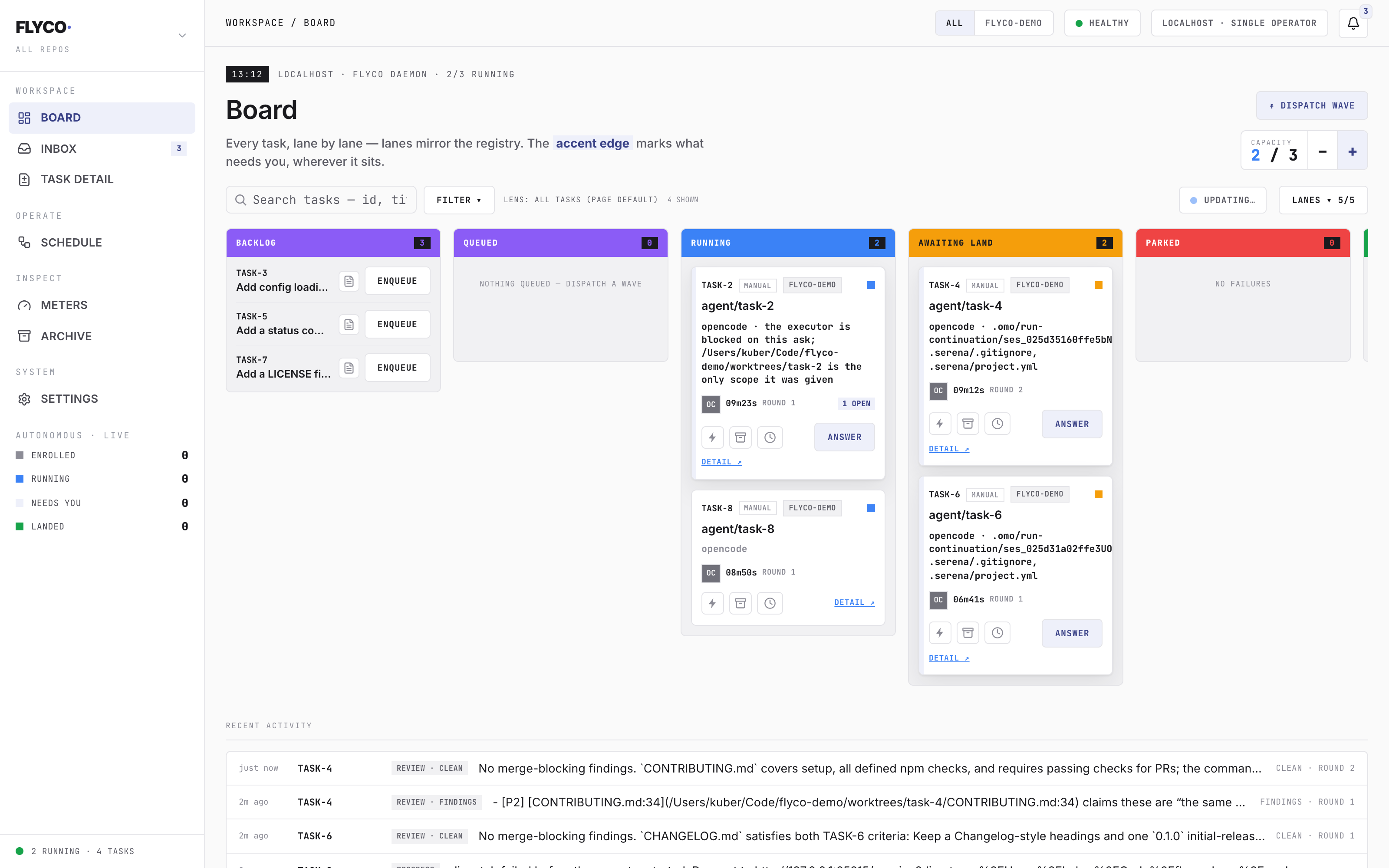
Fly through your backlog.
Your agents ship. You approve.
Your agents, cleared to land.
Stop reviewing diffs. Start answering exceptions.
An agent produced a diff. Now a human reads it and clicks merge.
The parallelism is real — you can run ten agents at once today. But nothing verified the work, so the bottleneck did not disappear. It moved to you, and it multiplied by ten. You are now the integration test, the code reviewer and the release manager for a fleet that never sleeps.
Flyco is built for what happens after the diff exists.
One task's life, start to finish. Nothing here is polling a loop and hoping; every transition is an event, and every decision is written down.
01 · ROUTE
The task is classified and matched to a model on an eleven-rung quality ladder, with automatic failover if a provider dies mid-run.
02 · ISOLATE
A fresh git worktree on its own branch, with its own allocated port so parallel dev servers never collide.
03 · EXECUTE
One agent session per task, supervised by events rather than polled.
04 · CHECK
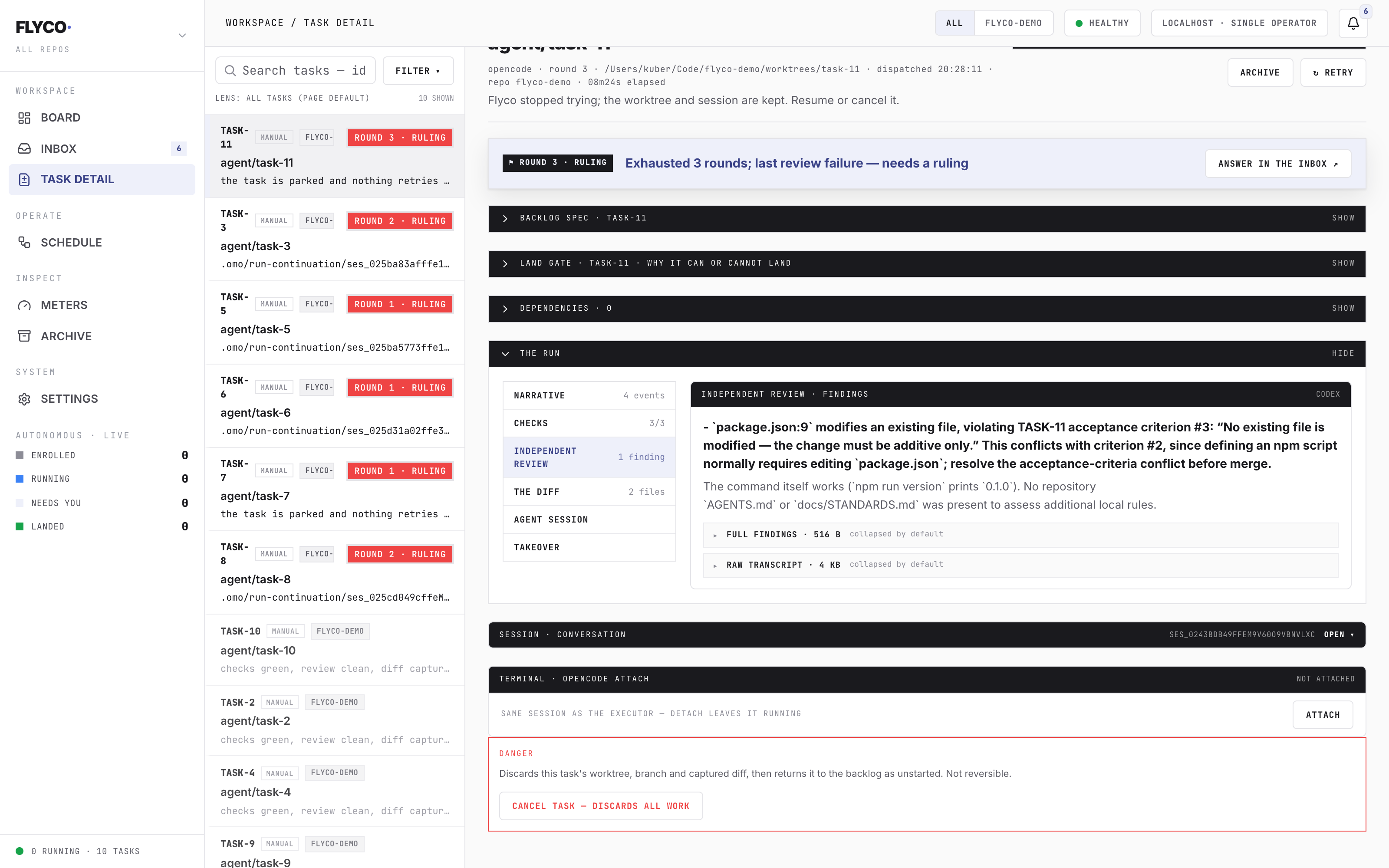
Lint, typecheck and tests, scoped to the packages the diff actually touched, with bounded timeouts. Red checks send the agent back with the failure, up to a budget.
05 · SMOKE
The app has to boot and answer a ready probe. A boot failure is a defect, not a flake, so it parks the task instead of retrying.
06 · REVIEW
An independent model reads the diff in a read-only sandbox and returns clean, findings, or error. Findings go back to the agent.
07 · GATE
Anything needing a human raises an exception with four verdicts available. Silence means handled.
08 · LAND
Patch-apply, then rebase fallback, then fast-forward only. One commit per task, linear history, re-verified at land time.
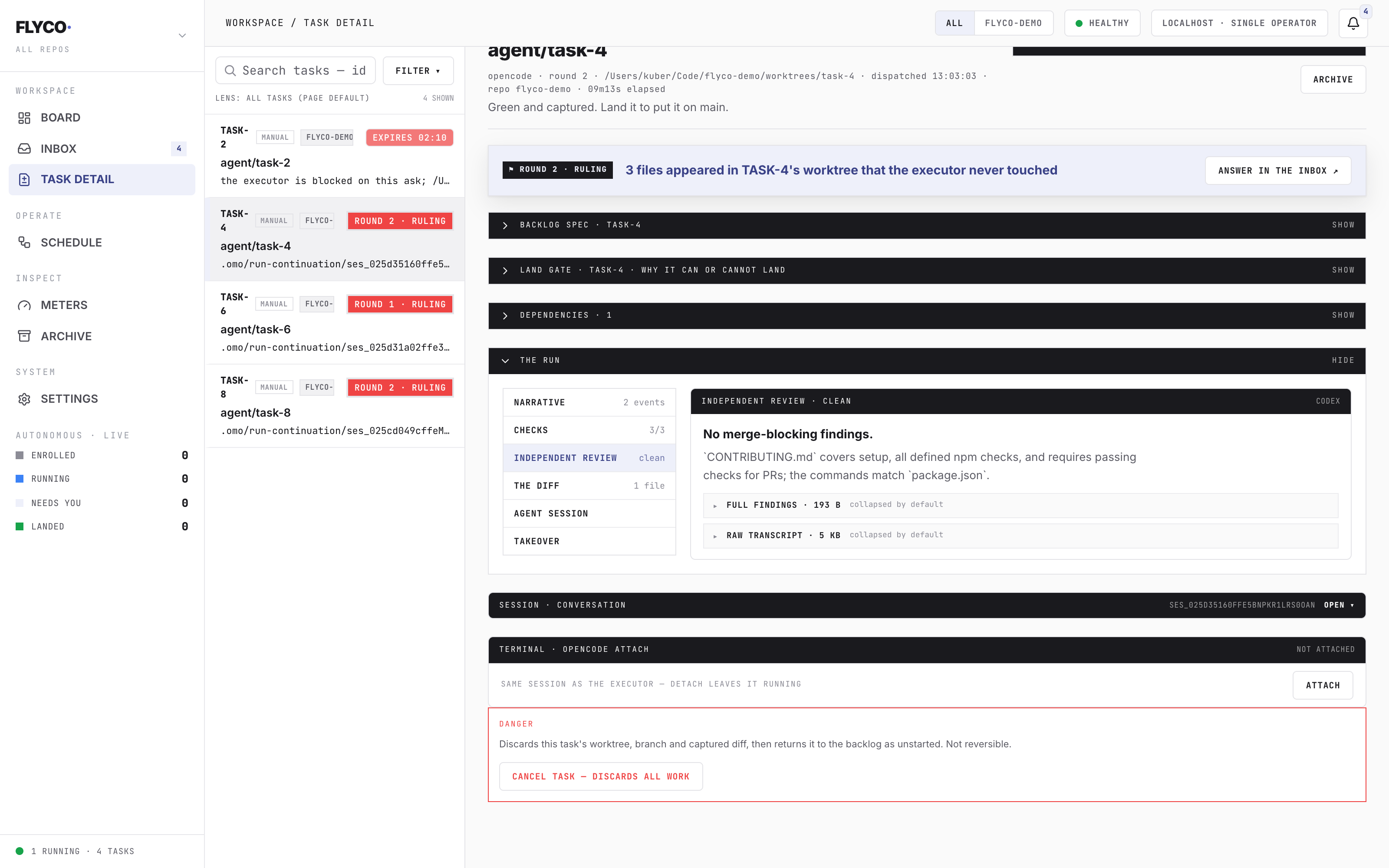
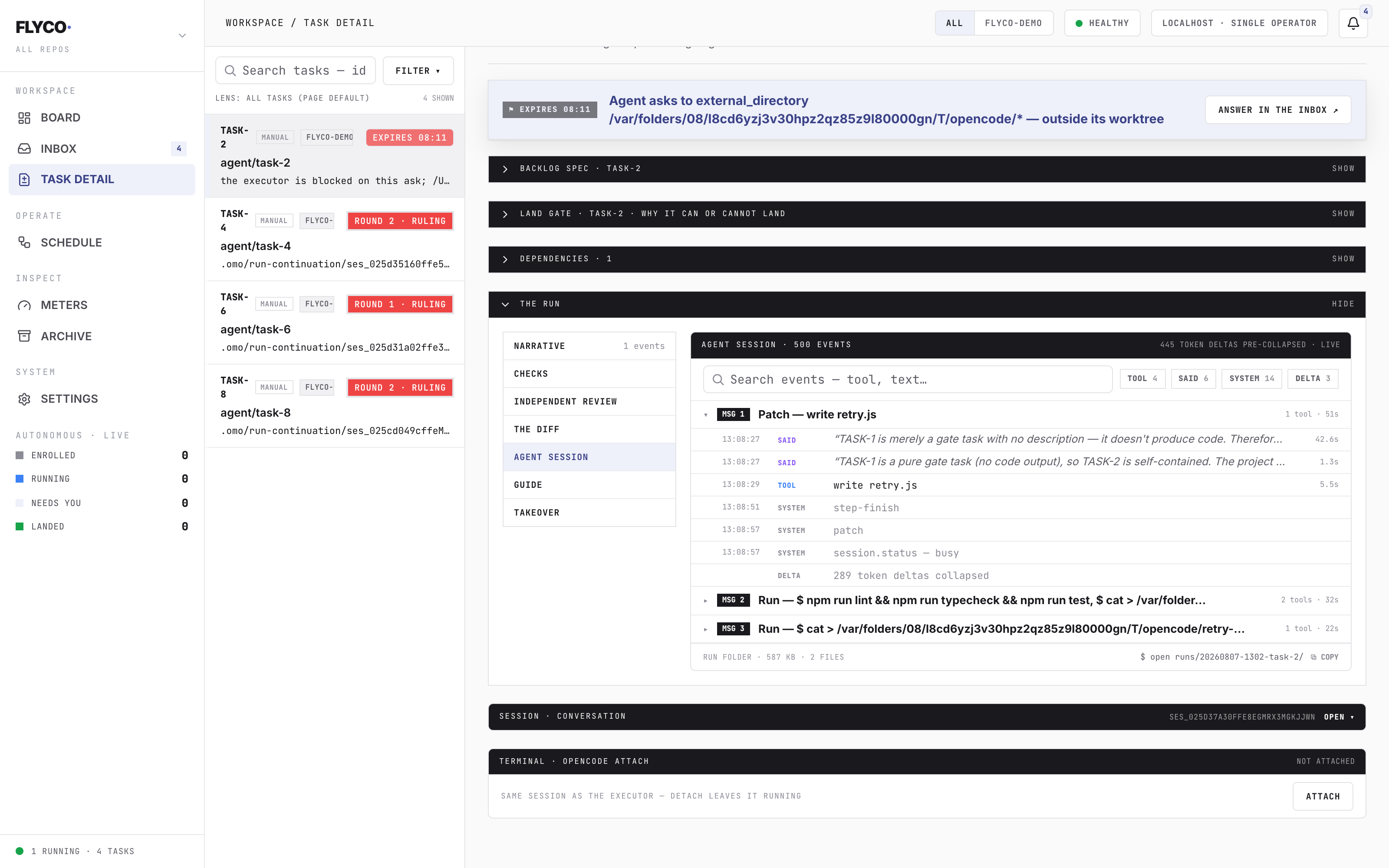
When an agent asks to do something outside its permitted envelope, Flyco raises a gate. You get four answers, not two.
Let it proceed. Optionally remember the answer so the same ask never interrupts you again.
Refuse the action. The agent continues without it.
Refuse the action and tell the agent what to do instead. Your steering goes into the live session; the agent keeps working.
Rewrite the action. The agent proceeds with your version instead of its own.
Every answer leaves a durable receipt. Every gate has a timeout, so an unattended run can never block forever.
Private beta opens in a few weeks.
Runs on your machine. Your keys, your repo, no account.
The cockpit
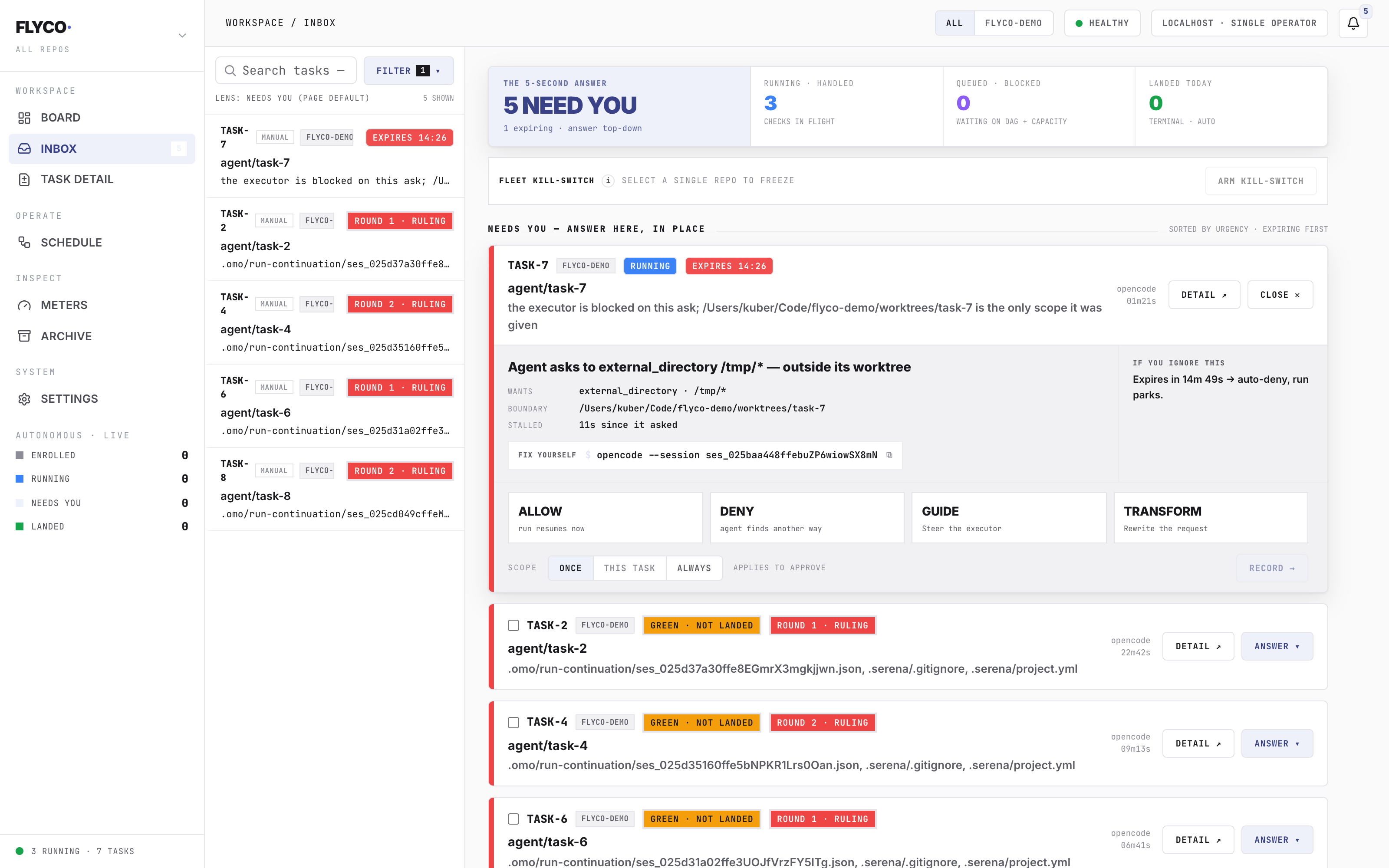
Lifecycle lanes, a task drawer with the spec and the pending decision, and an evidence dossier per task — the diff, the check output, the review verdict and a narrative timeline of where the time went. Drop into a live agent session over a real terminal when you actually want to.
Fleet safety
A landing kill switch that fails safe. A quota circuit breaker that trips the fleet on billing errors and fails open. A scheduler pause and a live capacity cap. Plus a per-task andon cord: freeze one agent without touching the other nineteen, take over its session by hand, then resume.
Model routing
Tasks are classified by risk and matched to a model on an eleven-rung ladder. Usage meters push work off a route before it hits a limit, health tracking walks down to the next rung when a provider degrades, and a dead session respawns on a different model in the same worktree.
Every repo, one daemon
Register as many repos as you work on. A single daemon multiplexes them, the cockpit scopes to whichever you are looking at, and all state lives in one folder you can tar up and move.
Flyco supervises coding agents through a capability-gated adapter, so the verify-and-land pipeline is identical whichever one you run.
More integrations are landing before launch.
Flyco is a single binary that runs locally. There is no hosted mode, no account to create, and no telemetry switched on by default. Your model API keys stay in your own config, and the agents talk to your providers, not to us.
Every state change is written to an append-only action log before it is applied. The log is the audit trail: it can be replayed to reconstruct the exact registry state, and a built-in verification pass proves the replay is byte-identical. If the process is killed mid-run, nothing is lost and every open decision is still open when it comes back.
Auto-landing is off by default. When you do turn it on, it is a policy conjunction with deterministic critics, and sensitive paths are forced to human-only regardless of the policy.
Leave an email and we will send an invite when it is ready. No drip sequence, no newsletter.
One email. One message when the beta opens.
No. Flyco runs locally as a single binary. There is no hosted mode and no account. Your agents talk to your model providers using your keys.
opencode, Claude Code, Codex and pi. Agents are supervised through an adapter seam, so the verify-and-land pipeline is identical whichever you use, and more integrations are landing before launch.
Only if you explicitly turn auto-landing on. It is off by default, and even then it requires a clean review, passing checks, deterministic critic approval, and a policy match — with sensitive paths always forced to a human.
Nothing is lost. State is written to an append-only log before it is applied, so a restart reconciles running sessions, reattaches the live ones and parks the rest for you to decide on.
Flyco is source-available, not open source. The full source is published and you can read it, modify it, self-host it and run it in production — but the licence reserves the right to sell Flyco as a competing service, so it does not meet the OSI definition and we do not call it open source. Some capabilities are reserved to a paid tier. Licence: FSL-1.1-Apache-2.0.
The beta is free. Some capabilities will be reserved to a paid tier after that; pricing has not been set, and this page will not pretend otherwise.